
Buying a library

Desperately seeking diversion from the midnight ravings of the squatter in the White House, I happened upon a story in the Times about another billionaire who has more shekels than sense. I refer to one John Caudwell who made his pile flogging mobile phones. Apparently, Mr Caudwell has bought a pied à terre in a new development in Mayfair where penthouses cost £200 million. If that makes your eyes water, you might consider a starter flat which can be had for a piffling £37 million.
So far, so what? But what distinguishes Caudwell from the oligarchs, sheiks, influencers, celebs and Eurotrash who, one suspects, will be his neighbours, is that he has hired a bookseller, Nicky Dunne of Heywood Hill Books, to “curate” - aaaargh - a library for him.
According to the Times’ hyperventilating hack, no one seems prepared to reveal how much Dunne is charging for his services though what he does say is: “A library is, say, £250,000 which is, of course, a lot of money - but compared to the price of contemporary art or even old art for some of these people, it’s really…it’s maybe one picture. And yet it seems to me that the library should be as important as the art on the walls.”
Amen to that. But what is not clear here is whether the quarter of a million is the sum set aside for the purchase of books or for Dunne’s expertise in choosing them. What we were told, however, is that Caudwell’s library will consist of 1,000 books, which he “in typically hyperbolic terms” mentioned in the same breath as the libraries of Aristotle, Alexandria, Pavlovsk (St Petersburg), Congress (c. 30 million books) and the Bodleian (a mere 11 million).
Predictably, the comments below the Times’ piece tended towards the derogatory. “I do hope the books are better written and more comprehensible than this article,” steamed one nitpicker. “These philistines don’t read,” raged another, “what is all this ‘curated’ carry on about?” “Bit of a stretch comparing a library filled with £250k of books to the Bodleian,” sniffed yet another. I was surprised, though, that no one felt it necessary to query the content of Caudwell’s collection which seems, from what he told the newspaper, to be confined to non-fiction books about London and novels set in London written by born Londoners or writers living in the Great Wen.
This did not suggest that Caudwell’s ‘library’ is likely to compare to those libraries mentioned earlier. But each to their own. What concerns me most about this venture is the idea that you can commission someone else to acquire books for you, which brings to mind those numpties who buy books by the yard simply to furnish a room and impress the gullible. To be effective these books need to look as if they have at least been opened. Perhaps Dunne will offer Caudwell an enhanced service similar to that envisaged by the great Flann O’Brien in the Irish Times in which, for an additional fee, books can be made to look as if they have been read. I should say at this point that if there is anyone out there who would like to emulate Caudwell do not hesitate to contact me. I may even be prepared to undercut Dunne’s estimate by a hundred thousand or two.
My own library, which is also my wife’s, has been decades in the making and consists - at a rough estimate - of some 20,000 books. A more exact figure is hard to determine because most of the shelves are double-banked. When I am called upon to explain why I have so many books I fall back on the excuse of a fellow bibliomaniac who always insisted that his collection was “a working library”. In the beginning, when I was younger and more impoverished, I bought books whenever I had a spare bob or two as a hedge against boredom. In my irrational mind, I foresaw a time when humanity’s existence would be threatened by the boredom equivalent of armageddon, when one would have no access to libraries or bookshops. Then, when all around me were suffering from terminal ennui, I would be smugly unaffected.
A personal library is organic and no two are alike. It is also, as Alberto Manguel, the bibliophile’s bibliophile, says in Packing My Library (2018), a form of autobiography, albeit one that may be difficult for the uninitiated to follow. Like Manguel, I have books that have been with me through most of my life. I know where they were bought and when, and sometimes I find tucked between their covers letters, postcards, business cards, scribbled notes, train and theatre tickets, restaurant bills and other ephemera which help jog my memory and send me down the chute of time in search of a lost self.
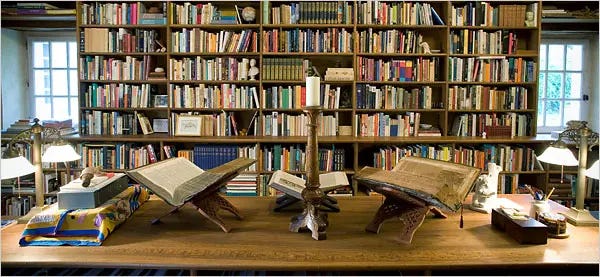
Year by year, title by title, the books accumulated. Having lived with them so long, I usually know where to find one at a moment’s notice. Unlike in a public library, which is arranged to allow all readers to locate a book they’re looking for, my library serves only the needs of my wife and me. To an untrained eye it may all look haphazard but it is not. It’s just that it’s ordered to suit our needs. Like Manguel, I rarely loan books, though I am always happy to gift them. What pains me, however, is when I recall giving away a book that was once prized but which I thought I would never read again. How I yearn to have it returned to its rightful place. Similarly, I have lost sleep over a book that I know is somewhere in this house but which remains at large. One such is the Collected Novels (Stoner, Butcher’s Crossing, Augustus) of John Williams published by Library of America. Where has it gone? Where might it be? Do get in touch if you have any light to shed.
One section in my library, a surprisingly large one, is devoted to books about books, which is where Packing My Library resides. Manguel’s library contains 35,000 volumes and his book about its removal from one rather large house to another much smaller one makes for painful reading. I recommend it to Mr Caudwell and anyone who believes it is possible to delegate the creation of a library. What Manguel says goes for me too: “I’ve often felt that my library explained who I was, gave me a shifting self that transformed itself constantly throughout the years.”
What tosh to think you can pay loads of money to someone and have an instant library. Libraries evolve, they are a work of love and a lifetime and are never complete. I'm glad to find I'm not the only one to loose sleep over a book not found. On some occasions I've been up into the wee small hours to find a recalcitrant volume and only then get rest. Good wishes to you both.
“Curated” has been annoying for quite some time now, so I’m glad it irritates you too!