
Harold who?

Here’s something not a lot of folk know: this year marks the 110th anniversary of the birth of Harold Robbins. What’s that I hear? Harold who? Your ignorance is unsurprising. Consulting my nearest-to-hand reference books, such as Margaret Drabble’s Oxford Companion to English Literature and William Rose Benét’s Reader’s Encyclopedia, I find no mention of Mr Robbins. He is also conspicuous by his absence in Robert Hendrickson’s indispensable The Literary Life and Other Curiosities, which is full of stuff you did not think you needed to know. A scientific survey of two friends who can usually be depended on for their intimate knowledge of the world of books likewise drew a blank. Harold Robbins, it would appear, has been wiped from literary consciousness, never to be revived. Take this piece, then, as a final attempt to bring him back from Hades.
I first read him as a teenager in search of something saucier than Peveril of the Peak. My gateway to his oeuvre was a novel called A Stone For Danny Fisher, which was first published in 1952. Like so many of Robbins’s books this became a movie, King Creole, starring Elvis Presley. I then graduated to what we might label his magnum opus, The Carpetbaggers, published in 1961, which grabbed me like a noose from its first sentence: “The sun was beginning to fall from the sky into the white Nevada desert as Reno came up beneath me.” Who, I immediately wanted to know, was Reno and what was he, she or it, doing beneath whoever “me” was?
The Carpetbaggers is as fat as War and Peace, which is perhaps where the comparison should end. Its hero is called Jonas Cord, Jr., who is un grand fromage in the airline and movie business. The plot, which covers a couple of decades, moves at a lick as Cord wheels and deals, and hops into bed like a flea flitting from one cowpat to another. Robbins, it must be said, seemed not to believe anything was untoward with any of this. His characters live for today and take whatever comes their way. They might not be completely morally bankrupt but they are maxing out their credit cards. Aficionados of his prose go in search of choice sentences like hunters scouring that Tuscan undergrowth for truffles. Here’s one: “I felt her shudder and tremble under me and a shrill scream came from her wings”. And another: “Finish your whisky while I get my dress off.”
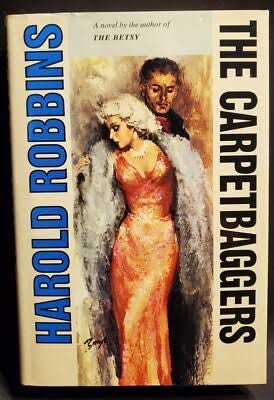
No longer having a copy of The Carpetbaggers, I am grateful for these examples to Ian Parker who, in 1996, wrote a profile of Robbins for The New Yorker. Robbins was then 80 and living with his 45-year-old wife Jann - otherwise known as Tootsie - in Palm Springs, California. Parker described his subject as “popular”, which was something of an understatement. Total sales of his books were at estimated to be 750 million; at one point he was said to be selling 40,000 copies a day. This may not be as many as the Bible but if you were to make me choose between rereading it and The Carpetbaggers I wouldn’t need to think twice. As for JKR, she has still a long way to go before she reaches Robbins’s tally. Not bad for someone who said of himself: “I’m the world’s greatest writer in basic English.”
Try as he might to get at the truth, Parker found Robbins to be evasive when talking of himself. Apparently, his early years were spent in a Catholic orphanage in Hell’s Kitchen, New York. Paul Gitlin, his former agent and friend, said his father was Jewish who married a woman who wanted children of her own and regarded Robbins as superfluous. When he was eight or so he was adopted by a Jewish family who moved from Brooklyn to Manhattan. He thought them “lovely” but he was badly behaved. “I used to deliver cocaine to Cole Porter,” he told Parker. Then, when twelve or thirteen, he began to attend burlesque shows favoured by dirty old men. “I would get a quarter to jerk them off,” Robbins recalled. “You know, I made a dollar, a dollar and a half, and I had enough money for the day.” There is more in similar vein which I’ll spare you.
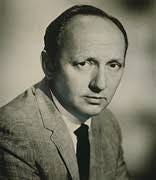
And so it goes. There was a spell in the Navy following which he had various occupations and ventures, one of which proved lucrative. Money came and went, which is a theme of Robbins’ career. When he was in the money he spent it, on yachts (several), houses (ditto), Rolls-Royces (nine), a Lear Jet (shared with Frank Sinatra and Sammy Davis , Jr.) women (innumerable), wives (one, three or five depending on who’s testifying), parties. He was not a bad looking fellow despite Parker’s description of his face looking like Gore Vidal’s with all the air let out. Picasso, a friend, drew him. Others who knew and liked him were James Baldwin, John Steinbeck and Norman Mailer.
According to legend, he became a writer after he made a bet with the Head of Production at Universal studio that he could better the kind of stories the company was paying a mint for. From this came his debut novel, Never Love a Stranger, which was Robbins’s own favourite. Mario Puzo, author of The Godfather, said he could have been a serious literary writer if he’d wanted to be. “A Stone for Danny Fisher was a literary book. But Harold was a smart guy, and he knew he was going to starve to death if he kept writing like that.”
He bashed out more than twenty novels, some of which pass muster, others which shouldn’t have passed go. No one knows exactly how many he actually wrote because as the years progressed his inclination to work faltered. Desperate, his publishers persuaded him (with the promise of a yacht among other furbelows) to put his name to books of which he was only titularly the author. What sold - what still sells - is sex, and Robbins, writing post Chatterley, Portnoy’s Complaint and Henry Miller’s Tropics, gave the public what it wanted, and then some. One of his admirers was Jackie Collins, who told me how big a fan she was of him. Like Robbins, she had no delusions about the company she kept. She did not want to be Proust or Joyce; they could have posterity, she wanted fame and fortune now. Jackie and Harold were peas from the same pod, dedicated disciples of the Johnsonian adage that no one but a blockhead ever wrote, except for money.
Sad to say I recognised his name right away...
Well that’s a blast from the past and a highly entertaining read. Thank you.