
Westward Ho!

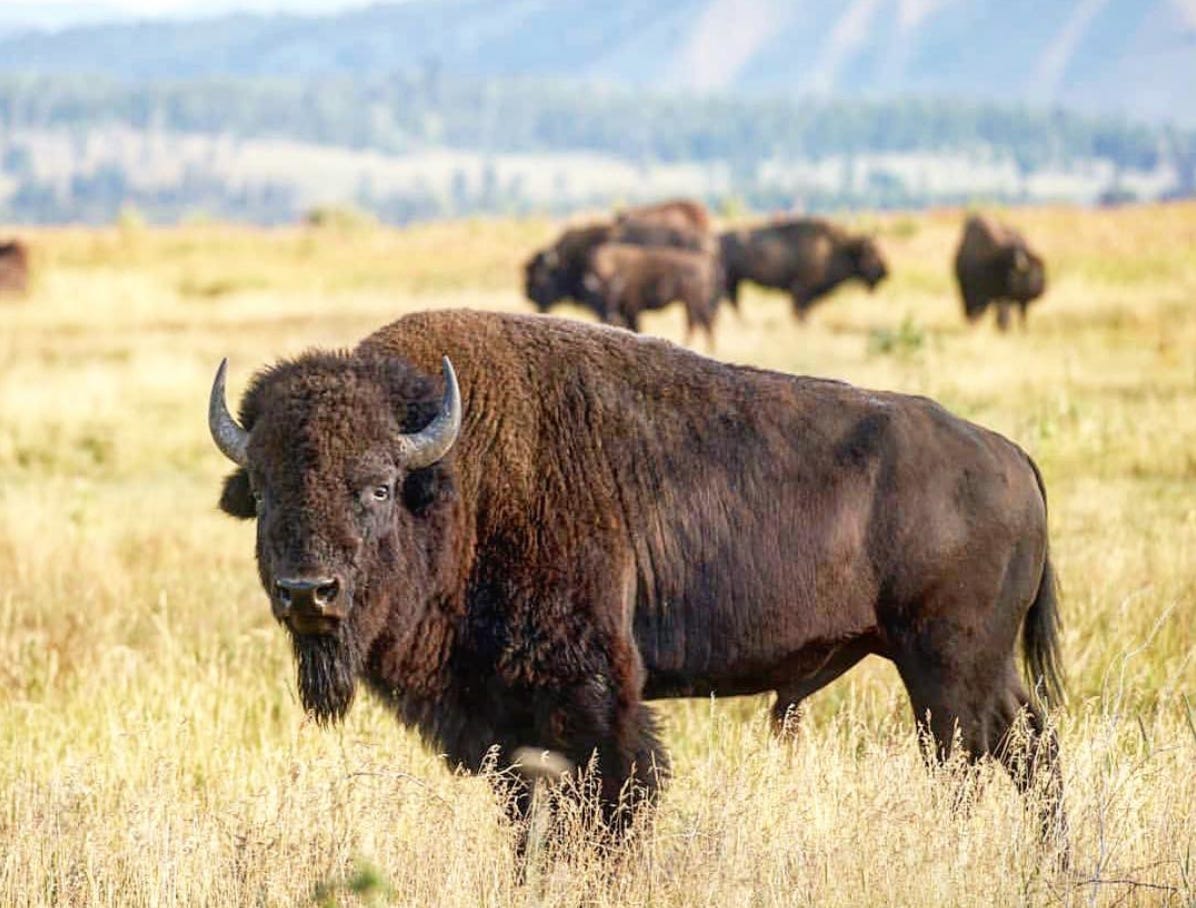
Before the arrival of white men, some seventy million buffalo roamed the great plains of America. Their principal predators were Indians who, when I was a boy, were called Red Indians, and who we now know as Native Americans. The buffalo made life tolerable in an inhospitable terrain. No part of the beast was wasted. The men were the killers while the women did the butchery, slicing the meat as thin as salami.
Each tribe had its own tradition. The Arikara, for instance, who had survived on the banks of the Missouri river for centuries until they were all but wiped out in the late eighteenth century by a smallpox epidemic, retrieved drowned buffalo that was so putrefied they could be eaten with a spoon. Unlike beef, buffalo meat did not quickly satisfy hunger. Some diners could consume fifteen pounds of it at a sitting, which puts into perspective the generous portions served in today’s fast food joints.
My interest in buffalo and those dependent on them was stirred by the republication of Butcher’s Crossing, one of a triumvirate of novels by John Williams included in a collection issued by Library of America, and which was adapted (rather well) for the movies in 2022. Williams is best known for Stoner, about a man whose youthful high hopes lead him to a cul-de-sac of disappointment and disillusionment. Such has been the acclaim belatedly – and justifiably – heaped on Stoner that it has tended to eclipse Williams’ other novels, especially Butcher’s Crossing, first published in 1960.
One reason for this may be its subject matter and its categorization as a ‘Western’, which is surely the most neglected and underrated of genres. The book is set in 1873 and located in the Kansas hamlet from which it takes its title. Its hero is a young man, Will Andrews, who has dropped out of Harvard and has travelled west looking for adventure. This is a scenario common to a number of earlier fictions with the West as a backdrop, such as Owen Wister’s much-reprinted classic The Virginians (1902) and Zane Grey’s equally popular Riders of the Purple Sage (1912). In the latter, Bern Venters ventures westward as a boy and returns a man. In each of these novels, the wildness of the West is formative and contrasts with a life of ease in the effete East. It toughens people up, tests their mettle and moral resolve, and revises their view of a country beset by growing pains.
Andrews falls in with a trapper called Miller who tells him about a mythical herd of buffalo. For reasons that are not entirely clear, Andrews agrees to fund an expedition to find it. He and Miller are gripped by the kind of fever that led others to flock to the Yukon in search of gold. Many buffalo will be slaughtered for that is what white men did in their lust for blood and their desire to profit from the trade in hides. In contrast, the indigenous inhabitants of the plains appreciated that their continued existence rested on that of the animals and, in general, they were frugal hunters.
As in all the best westerns, Butcher’s Crossing glories in description. “The great plain,” writes Williams, “swayed beneath them as they went steadily westward.” Meanwhile, the grass changes colour as the day progresses; nearly gray in the morning, bluish by noon, yellow-tinted come afternoon, purple-hued when the sun went down, “as if it absorbed all the light from the sky and would not give it back”.
Here is America in the raw, in its elemental, immense and perilous emptiness, where journeys are measured by the distance a horse can carry a rider and access to water is imperative. Here, too, we see the birth of a nation and with it the intrepidness of pioneers, the greed of opportunists, the marginalisation and decimation of the native population, and the unchecked progress of so-called civilization and urbanization.
Given the place of the West in its nation’s history, it’s odd that western novels have dropped so far down the literary pecking order as to be almost invisible. Bookshops don’t devote space to them and publishers seem disinclined to add any to their lists. Meanwhile writers – with a few notable exceptions, Cormac McCarthy, Ron Hansen (The Assassination of Jesse James by the Coward Robert Ford), Annie Proulx and, especially, the late Larry McMurtry – find their inspiration elsewhere. To them the West appears alien, untouchable, unknowable. Another significant factor in the genre’s decline may be the dearth of TV programmes and movies featuring “cowboys and indians” which, a few decades ago, were as ubiquitous as Scandi Noir and are presently as endangered as buffalo in the era of industrial revolution.
Lamentable as all this may be, fans of westerns have of late been cheered by Library of America’s revival of the genre. As well as the Williams’ volume, it has collected four novels and eight short stories by Elmore Leonard, including three – Hombre, Valdez Is Coming and 3:10 to Yuma – which have been filmed. LOA has also disinterred from literature’s Boot Hill a quartet of classic westerns from the 1940s and ’50s , including The Ox-Bow Incident by Walter Van Tilburg Clark, Oakley Hall’s Warlock, Shane by Jack Schaefer and Alan Le May’s The Searchers.
When I managed to lasso the 1,100 page volume away from my horse-mad wife, I read The Searchers which, when filmed by John Ford, was voted the Greatest Western Movie of All Time by the American Film Institute. The novel, which describes the six-year-long quest of two cattle men to rescue a young girl abducted by the Comanche, is pretty special too. What is fascinating about Le May’s approach is his even-handedness. There is no denying that the Comanche were terrifying and unspeakably cruel, but one senses that Le May, who drew on a real-life story, was not unsympathetic to their plight. Like the buffalo in Butcher’s Crossing, they faced extinction. Unlike them, however, the buffalo were helpless in the face of slaughter. The killing went on unchecked as, indeed, it did, as witnessed by John Williams during World War Two. For him, what happened to the buffalo was analogous to what human beings did to one another, which may be why he insisted his publisher not put “A Western” on the cover.